
Early life and adoption
Maria Burton Carson was born in Germany in 1961 and became part of Hollywood history when Elizabeth Taylor adopted her as a child. Taylor began the adoption while married to Eddie Fisher and after marrying Richard Burton the couple finalized Maria’s place in their family; Burton later adopted her as well. That early passage—from an orphanage in Germany to the living rooms of a global celebrity household—meant Maria was raised amid travel, medical care and intense media curiosity.
A private life in a very public family
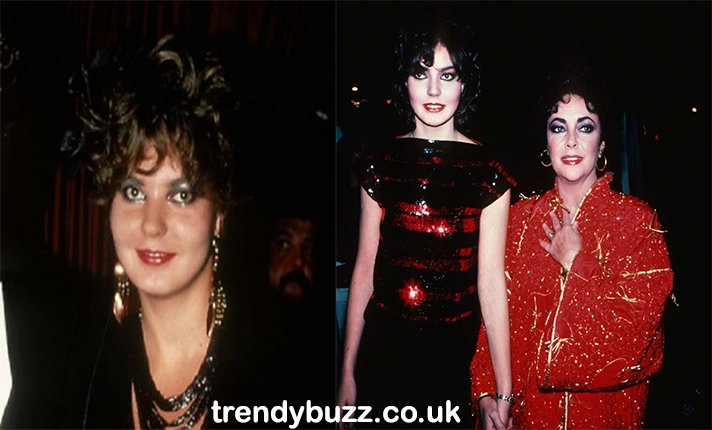
From the start, Maria’s public record is patchy by design. Although she was present at parties and social events in the 1970s and 1980s, she never made the press a full-time project. Photographs held in archives and agencies capture her at a few high-profile moments, but those images are snapshots rather than a continuous public biography. That patchwork of photos—in collections such as Getty Images—helps explain why Maria is known to the public mostly as “Taylor and Burton’s daughter” rather than through a detailed, self-authored narrative of her life.
Career marriage and family
As she matured Maria tried her hand at modeling and some fashion interests, and eventually focused on building a family. She married Steve Carson and raised children; over the years, reporting and family notices note grandchildren and family participation in memorials and charitable efforts tied to Elizabeth Taylor’s legacy. Journalistic accounts emphasize Maria’s preference for a private life centered on home and children more than a career in front of cameras. For those studying Hollywood families her choices are a reminder that not every descendant of a star pursues public visibility.
Relationship with her mother and legacy work
Elizabeth Taylor described motherhood as personally central, and she both provided care and protected her children when needed. Accounts note that Taylor oversaw medical treatment and supported Maria through health challenges early in life; the family later participated in philanthropic efforts that preserve Taylor’s legacy. Maria herself rarely steps forward as a public representative of those causes, but family members and descendants have carried the torch in various ways that keep the family’s charitable work and memory alive.
Notable public moments
If you look through magazine retrospectives and event photography you will find Maria at a handful of moments—fashion displays, family celebrations, and ceremonies honoring her parents. Those images show someone comfortable in creative circles and at family gatherings, but they do not build a continuous media persona. The result is a public record that feels occasional and respectful of boundaries. Those interested in visual documentation can find many of those images and captions in archival photo services and retrospective galleries.
How journalists cover a private family member
When writers set out to tell Elizabeth Taylor’s story, they must decide how to treat relatives who prefer privacy. For Maria the pattern has been consistent: reporters rely on adoption records, archival photos and family statements, and then move on to the more documentable chapters of Taylor’s career and activism. That approach produces accurate reporting about the family while also leaving wide blank spaces where a dedicated profile of Maria would be required. Those gaps mean readers must be cautious about drawing sweeping conclusions from limited public material.
Public perception versus personal reality
It is tempting to reduce Maria to a supporting cast member in a famous couple’s drama, but that framing flattens a more complex life. The choices required by a private adult—managing relationships, parenting children, handling privacy—are ordinary and consequential. Maria’s story shows that the offspring of celebrity can choose stability over spectacle, focusing on family rhythms rather than headline-making behavior. That decision shapes how the public remembers her and how historians will account for her role in the family.
Where she is now
Contemporary reporting and social archives indicate Maria has stayed largely out of the spotlight. When modern outlets mention her it is usually in the context of family memories, charity work carried on by relatives, or archival celebrations of Elizabeth Taylor and Richard Burton. That low profile has persisted for decades: by design it keeps private matters private while allowing her to take part in family occasions when she wishes. For readers, that means most available coverage will be brief mentions or photographs rather than long interviews or memoir material.
What Maria’s story tells us about fame
Being raised by two global stars rewrites many assumptions about opportunity and the costs of visibility. Maria’s life suggests a different equation: access without spectacle, connection without performance, and the decision to put family first. Those quieter trades are neither sentimental nor small; they are deliberate and worthy of attention on their own terms.
Sources and a note on research
This article draws on mainstream profiles and archival records about Elizabeth Taylor and her family, and on photo collections that document public appearances. Key contemporary sources that provide reliable context include ABC News (on adoption and family), People magazine (on the children and descendants), Getty Images (photo archives), and InStyle (retrospectives that discuss public perception). Because Maria has chosen privacy, primary interviews and long-form profiles focused solely on her are scarce, and that scarcity is itself part of the story.
Closing reflection
Maria Burton Carson’s life is a reminder that not everyone born into fame accepts an assigned public identity. She appears to have made a clear choice for privacy and family, and that choice is as meaningful as a public career. In stepping back, she created a quiet life in extraordinary company — a quiet choice. Her example invites us to value discretion and ordinary care as legitimate forms of legacy in an age of spectacle and respect.
