
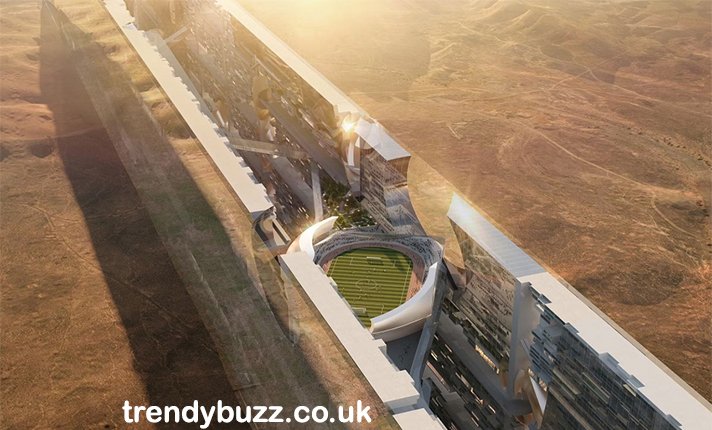
The Line was announced as part of Saudi Arabia’s Vision 2030 and pitched as a radical reimagining of urban life. The concept proposed a continuous, mirrored urban ribbon that would run for many kilometres, concentrate high-density living into a narrow footprint, eliminate the need for cars, and place all essential services within a five-minute walk. The original renderings showed a sleek, 500-metre-tall structure hugging desert and coast, promising both technological futurism and environmental efficiency.
At first glance, The Line captured imaginations. Planners and investors and a curious global public responded to the clarity of the narrative: a compact, walkable city that protected surrounding land and unlocked new models for mobility and energy. The idea also fit neatly into broader trends in urban thinking that value density, mixed-use development, and transit-oriented design.
However, the project quickly encountered friction. Independent reporting and financial disclosures pointed to repeated revisions of scale, extended timelines, and evidence that only a fraction of the proposed length was moving beyond preparatory work. What began as a visionary skeleton faced the blunt realities of cost, engineering complexity, market shifts, and governance. Contractors have at times scaled back work and several news outlets reported that original ambitions were pared back in favour of much smaller near-term builds.
Beyond technical and fiscal constraints, The Line has been a flashpoint for social and environmental controversy. Human rights organizations have raised concerns about displacement of indigenous communities and working conditions for labourers on NEOM sites. Conservationists worry about the ecological footprint of constructing a monumental linear form through sensitive coastal and desert habitats. Those criticisms underscore the friction between ambitious design and the rights and needs of people who live and work near project areas.
Defenders of the concept argue that, if executed with discipline, the Line’s geometry could deliver measurable sustainability benefits. A narrow urban form reduces direct land take, shortens journeys, and allows for centralized systems for energy, water, and waste that can be optimized at scale. Moreover, integrating mass transit and digital management could reduce per-capita emissions and encourage healthier, more walkable daily patterns.
Recent coverage suggests a pragmatic recalibration rather than wholesale abandonment. Reports indicate a shift toward phased delivery, pilot districts, and more modest near-term targets while preserving the broader rhetorical vision. Financial filings from state entities show impairments to project valuations and public discussion about reprioritising spending across several giga-projects, which has prompted planners to define nearer, deliverable milestones.
What lessons should planners and publics take from The Line experiment? First, visualization and marketing cannot substitute for clear, accountable staging. Large infrastructure programs require transparent phasing, robust environmental baseline studies, and meaningful community consultation before major earthworks commence. Second, sustainability claims must be matched by enforceable labor protections and by design decisions that enhance rather than fragment ecological networks.
There are also pragmatic design takeaways. The central idea of compressing amenities to reduce travel time is valuable and transferable. Small-scale pilot neighborhoods that test energy recovery systems, water reuse approaches, and autonomous shuttle technologies can demonstrate feasibility without demanding immediate city-scale replication. Incremental pilots also provide opportunities to refine governance models and procurement approaches that protect workers and local residents.
For policymakers, the case highlights the value of realistic financial planning and flexible governance. Megaprojects that are tightly tied to a single, charismatic timeline are vulnerable to market shifts and political changes. Diversifying financing, publishing transparent progress reports, and involving independent auditors and civil society can increase credibility and reduce the risk of social backlash.
From a broader urban perspective, The Line serves as both a provocation and a warning. It provokes because it forces architects, planners, and citizens to think hard about density, mobility, and the relationship between built and natural environments. It warns because it shows how quickly grand narratives can outpace operational realities and local rights.
Ultimately, the value of The Line will be judged by outcomes rather than renderings. Affordable housing delivered on schedule, protected ecosystems, fair labor conditions, and demonstrable gains in energy and water efficiency are the tangible measures that matter. If scaled-back pilots or reconfigured districts can deliver those outcomes and then be scaled responsibly, The Line may leave behind useful, transferable lessons even if the original, dramatic ribbon never fully materializes.
The conversation around The Line also suggests a healthier future approach to ambitious urban innovation: dream boldly, but test early, govern transparently, and measure relentlessly. Cities of the future require both imagination and humility. The Line’s story should encourage both, reminding designers and decision makers that the most enduring urban legacies are those that improve everyday life for broad populations rather than simply impressing with spectacular form.
There are precedent models and modest successes that illustrate the route from visionary ambition to workable urban change. In cities across Europe and Asia, compact neighborhood projects have shown that prioritising public transit, generous cycling infrastructure, and mixed-use planning produces measurable gains in quality of life and emissions reductions without requiring megastructures or exotic materials. Those projects succeeded because they started small, measured impacts, adapted rules and funding streams, and used civic institutions to manage tradeoffs. Translating those sensible steps to a project the scale of The Line means insisting on phased trials, transparent procurement, and independent monitoring. It also means embedding a clear human-rights framework into contracts and site-management plans so that local residents and workers have enforceable protections. For governments sponsoring large symbolic projects, the balance to strike is between the value of bold, attention-grabbing announcements and the inherent need to build capabilities on the ground. A strategic pivot toward smaller, replicable pilot investments can preserve the innovation impulse while reducing fiscal and social risk. Investors, municipal authorities, and designers can then treat each pilot district as a laboratory where technologies and governance models are stress-tested before being scaled. This approach converts a single grandiose promise into a portfolio of accountable experiments that together can still advance ambitious environmental and social goals.
